Chinese Stuffed Eggplant

Fragrant and savory eggplant layers!

Cooking Summary
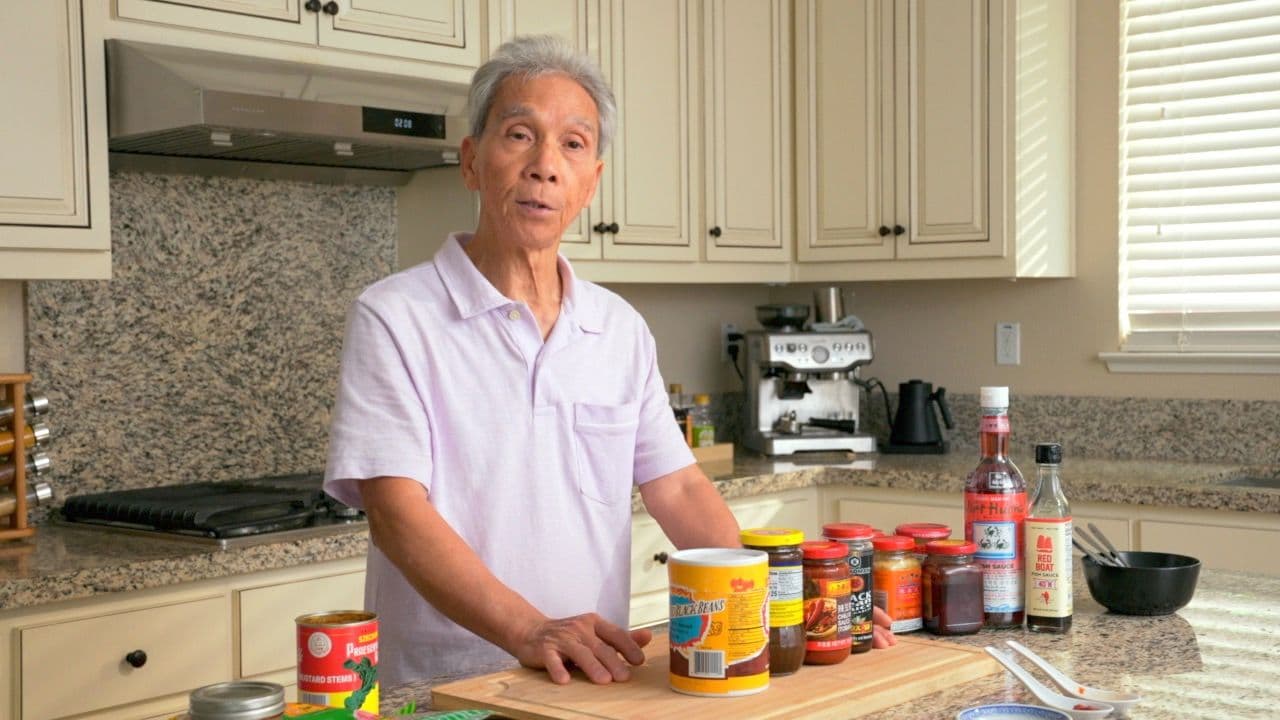
Ingredients: (detailed list)
- Main Ingredients: Chinese eggplant, shrimp, tonguefish fillet
- Filling Marinade: salt, sugar, cornstarch, white pepper, sesame oil, water
- Sauce: garlic, chili pepper, ginger, sugar, light soy sauce, dark soy sauce, oyster sauce, vinegar, water, chili sauce, cornstarch, sesame oil, corn oil
- Other: corn oil, water
Jump To Section
Top 3 Mistakes
- Cutting through the hinge:
Leave the paired eggplant slices attached at one edge. That hinge helps hold the filling in place, so avoid cutting through it or squeezing hard enough to push the paste out.
- Leaving the filling coarse:
Smash and chop the shrimp until the paste becomes fine and sticky. Stopping at a rough mince skips the texture-building work that helps the filling hold together inside the eggplant.
- Leaving ingredients too wet:
Drain and dry the ingredients as directed before they reach the pan. Extra water changes how they cook, making it harder to get the browning and texture the recipe calls for.
Overview
Our Stuffed Eggplant recipe completes a trio of delicious stuffed dishes that's found in Hong Kong streets under the name "Three Treasures".
The street food versions are actually deep-fried, but to make it friendlier for home-cooking, our recipes involve only steaming and pan-frying.
These stuffed dishes are our family's favorite indulgences, and we're so excited for you to try them out!
Ingredients
Why this recipe
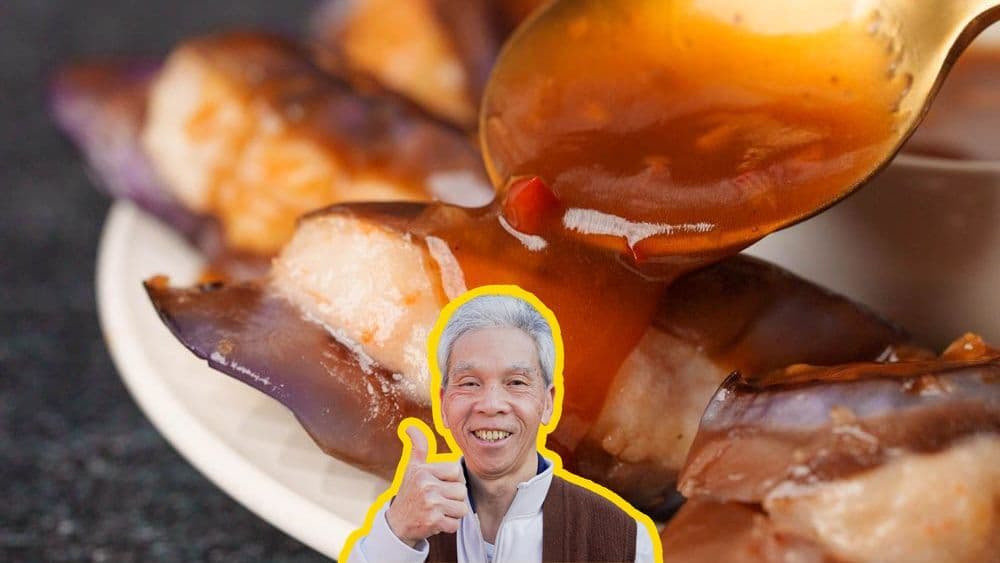
Most chinese stuffed eggplant recipes online are tested only a handful of times. My dad used to make this dish multiple times a day, every day, for 60+ years and can make this in his sleep.
I know you'll love it as much as our community does! This recipe has over 149.3K views, 3.2K likes on YouTube.
Choosing eggplants
For this recipe, we always use Chinese eggplant. Any long, slender eggplant, like Japanese eggplant, will work perfectly.
American eggplant, which is stout and round, won't work as well. The slices would be too big and floppy. If American eggplant is all you have access to, you may want to experiment with the shapes and consider deep-frying rather than pan-frying. Let us know what you come up with!
Accompanying sauces
Our stuffed eggplants are the third stuffed dish that we've covered so far in our Made With Lau catalog. Previously, we've also shared our recipes for Chinese Stuffed Peppers and Steamed Stuffed Tofu.
Although the fillings for these three dishes are identical, there are three distinct sauces to accompany each dish.
We make a yuxiang sauce, which is a garlicky soy sauce, to go with Stuffed Eggplant (this recipe). Our family prefers to pair the yuxiang flavor with eggplant, which you'll also see in our recipe for Eggplant with Garlic Sauce.
For Stuffed Peppers, we make a smooth black bean-based sauce. If you prefer chunky, though, that works too! The savory, slightly funky flavor of fermented black beans balances the sweetness of the peppers.
For Stuffed Tofu, we make a mild oyster-fish sauce mix, so as to not overwhelm the delicate flavor and texture of the tofu.
These are our family's own preference. You can definitely explore other sauces and pairings. In fact, go wild and throw some homemade chili sauce on!
How to make Chinese Stuffed Eggplant
Start by preparing the filling, which will be a fish and shrimp paste. If you wish, you can opt for only fish, only shrimp, or any combination of proteins, like ground pork or beef. While you can sometimes buy this at a Chinese seafood counter, it's good to know how to make it from scratch!
Start by cleaning and peeling the shrimp (7 oz). To peel the shell off, twist and wiggle the tail off. Then, hook a finger under the remaining shell and pull it straight off. If the shrimp is not de-veined already, slide a toothpick or tip of a knife under the dark vein and pull it out.
Give the shrimp a quick wash with clean water to rinse off any debris and shell bits. Squeeze all the water out, and then set it aside.
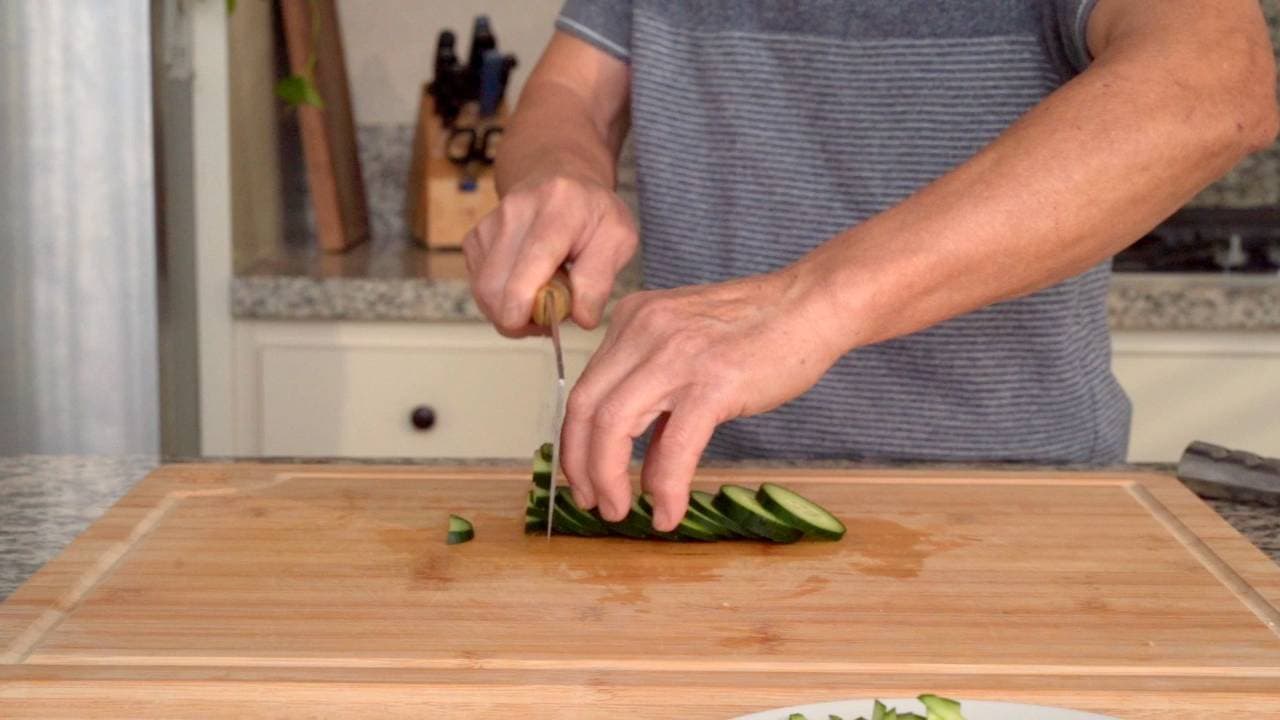
Prepare the fish fillet (7 oz) by patting it dry with a paper towel. Then, lay it down on your chopping board and cut it into thin slices. Once the fish is all chopped into thin slices, you're going to start smashing it. It's best to use the broadest knife you have for this, the closest thing you have to a cleaver.
Grip your cleaver high on the handle, extend your index finger out to push down on the blade, and turn the cleaver horizontally. Carefully smash the fish slices down into the cutting board. You won't need a lot of sudden, dramatic force, as the fish is delicate and will succumb easily to smashing.
The smashed fish slices should begin to form a paste, and as you go through the fish, gather it back up into new piles to smash again. It should get stickier and more paste-like with the second pass.
Then, return to a normal knife-holding position and give the fish paste a thorough chop. This will severe any remaining long strands of connective tissue and ensure that the fish paste is nice and soft.
Next, start making the shrimp paste. There's no need to slice it first, so proceed directly to smashing. After smashing the shrimp, then chop it thoroughly. Gather the forming shrimp paste together and smash it further to get the paste even finer and stickier.
Next, mix the fish and shrimp pastes together. Fold them together, then give this mixed paste another thorough smashing.
Now that we have the shrimp and fish paste, we can finally marinate it. Add white pepper (0.25 tsp), salt (0.50 tsp), sugar (0.50 tsp), cornstarch (1 tbsp), and water (2 tbsp) to a bowl. Mix it up and pour it over the shrimp and fish paste.
Mix it very, very thoroughly until the paste has absorbed the marinade and become a sticky paste. The more you mix it, the bouncier and chewier your paste will be when you cook it!
Put the shrimp and fish paste into the refrigerator to chill while you prepare the eggplant in the next step.
Trim off the stem and the end of the eggplant.
We want to end up with a 1/2-inch thick piece of eggplant (1 lb) with a slit in the middle, where we're going to put the filling. The slit will go about 3/4 of the way through, so that the top and the bottom of the eggplant can both sandwich the filling and stay intact. We're also going to cut our slices at an angle, so each piece will be longer, with more surface area.
The first cut, 1/4-inch from the end, will become the slit, so angle your knife and cut 3/4 of the way through the eggplant. Make the second cut all the way through. The entire piece should be about 1/2-inch thick. That's your first piece of stuffable eggplant! Repeat with the rest of the eggplant.
Once all the eggplant is sliced up, take your filling out of the fridge. Use a spoon to scoop the filling into the eggplant slices, then use the edge of the spoon to wipe and clean the sides.
As for how much filling goes into each piece, that depends on how many pieces of eggplant you were able to cut. Fish and shrimp cook through rather quickly, so you can use a lot of paste.
Smash, peel, and mince the garlic (2 clove).
Smash and mince the ginger (3 slice).
Trim and discard the stem of the chili pepper (1 whole). Then, cut it open, slice thin strips, and mince the chili pepper finely.
Set the minced garlic, ginger, and chili pepper aside.
In a separate bowl, combine sugar (2 tbsp), light soy sauce (2 tbsp), dark soy sauce (1 tbsp), oyster sauce (1 tbsp), vinegar (1.5 tbsp), and water (5 tbsp). Here, you can give it a taste and adjust to your preferences.
Add cornstarch (2 tsp) and chili sauce (0.50 tsp) and mix well to combine.
Set your stove to high and heat up a flat-bottomed frying pan or skillet. When the pan is hot, add oil (2 tbsp) and swirl it around. Turn the heat down to medium or low.
Add the stuffed eggplant pieces one at a time. When they're all in, you can optionally add more oil (1 tbsp) along the edge to help the eggplant fry up even more nicely.
Cover the pan with a lid and let it cook on low for a minute. As it cooks, you can jostle and nudge the pan around to help the eggplant cook evenly.
After a minute, uncover the lid and check the eggplant. If the bottom of the pieces are golden brown, flip to the other side. Then add more oil (1 tbsp) and shake and tilt the pan around to help distribute the oil. Put the lid back on and cook for another 30 seconds.
Then, turn the heat up to high and add water (2 tbsp) to the pan. The high heat will help heat the water quickly so that it can turn to steam. Once the water is in, turn the stove off, and put the lid on. Let it steam in the covered pan for 2-3 minutes.
After 2-3 minutes of steaming, the eggplant and filling should be completely cooked through. To cook some of the moisture off, set the stove back to high heat for 15-20 seconds. Then, plate the cooked stuffed eggplant and set aside.
Clean and dry your pan, or use a new pan to cook the sauce.
Set the heat to low, add oil (1 tsp) to the pan, and swirl to distribute. Add the minced garlic, ginger, and chili pepper and fry them until they're aromatic, or about 20-30 seconds. Then, pour in the sauce, stirring constantly. Turn the heat up a bit to help the sauce come to a boil. Once you see it boil, it's ready. If it's too thick, you can add water to thin it to your desired consistency.
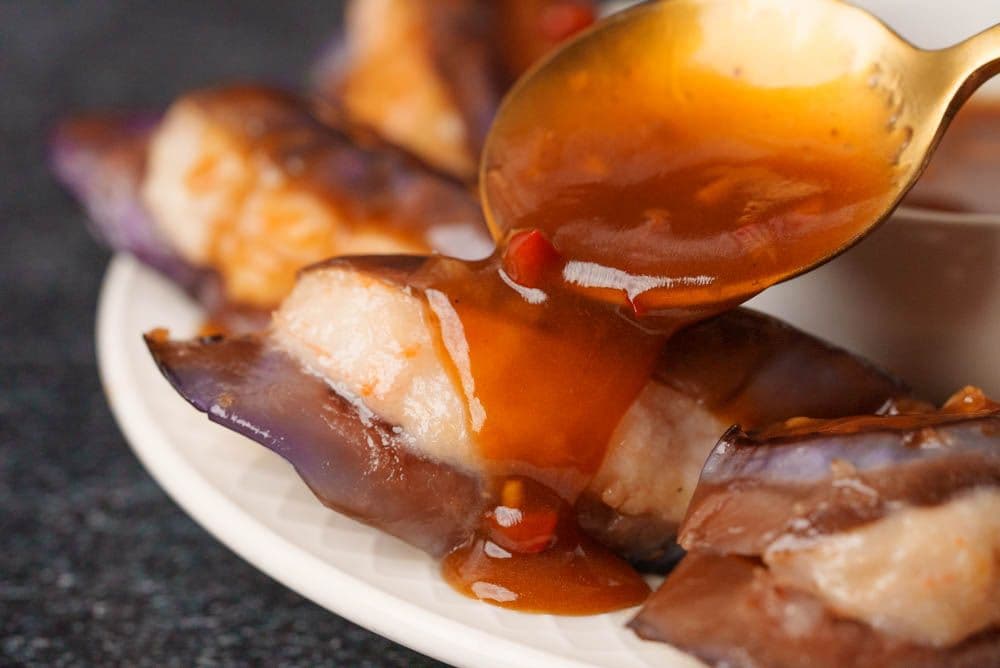
Turn off the heat and mix in sesame oil (1 tsp). You can either serve this sauce next to the stuffed eggplants, or drizzle it over the top. Enjoy!
Frequently Asked Questions
Is frozen shell-on shrimp fresher than prepeeled shrimp?
Shell-on shrimp should be fresher than pre-peeled shrimp. If you get to choose, always go for shell-on and then peel it yourself.
Do I have to make fish paste from scratch?
Nope! You can definitely buy premade fish and/or shrimp paste from your local Asian grocery store, if it's available.
A nice middle ground might be to buy the fish and shrimp whole, prep them as we show you in the recipe, but use a food processor instead of smashing the filling into paste by hand. You can get a really beautiful paste using a food processor! Old school is a vibe, not a requirement.
Can you use a food processor to make fish paste?
Yes, absolutely! It's a much faster, more convenient method than smashing it by hand.
If you're making a combined paste like us, shrimp and fish, then process each ingredient individually and then combine them by hand.
How do you prevent the filling from falling out of the eggplant?
Although the filling is stuffed between two slices of eggplant, the eggplant slices are actually still attached. Think hot dog rather than hamburger, where the top and bottom buns are still attached by a hinge. Don't let that hinge break, squeeze firmly but gently so you're not squeezing the filling out, and all the delicious filling will stay put!
How do you prevent eggplant from discoloring when cooked?
Eggplant will always darken when cooked, it's very difficult to work around that. For presentation, focus on getting a beautifully golden-brown sear on the surface of the eggplant slices, and no one will even think about the less-than-purple skin.
Pairs well with
View all →

Made with love ❤️
We started Made With Lau to celebrate Cantonese culture and honor the legacy of our wonderful parents, Jenny and Chung Sun Lau.
Our hope is that these recipes and stories help you spread the joy, love, and nostalgia that I felt growing up.